TL;DR
A whole house water filter can reduce shower pressure. Check tank height, the valve, backwashing and filter placement before adding a booster. Book a visit.
Yes. A whole house water filter adds some resistance while water is flowing through it. Whether that makes your shower feel weaker depends on the tank height, plumbing, filter size and upkeep. We check those together when planning an installation.
A weak upstairs shower, a drop when another tap opens, and flow that slowly gets worse can point to different problems. Start with what you can observe. The installer can then check the pressure and flow before choosing a change.
Notice when the shower gets weaker
Try the shower on its own, then notice what happens when another tap is used. Compare upstairs and downstairs. These simple observations help us find where to look; they are not a pressure test.
- Weak only at one shower: have the showerhead and its supply checked
- Weak upstairs but comfortable downstairs: check the tank height and the supply to that floor
- Weak when taps run together: check how much water the filter and pipes can pass at once
- Good at first, then gradually weaker: check filter cleaning and backwashing
Pressure is the push moving the water. Flow is how much water reaches you over time. A shower can feel weak because the path to it cannot pass enough water when other taps are open. The installer needs to check the supply while water is running.
Check the narrowest passage
A wide pipe can meet a smaller passage inside the filter valve. That smaller passage can hold back the water even when the pipe outside looks large enough.
For a gravity-fed installation, we check the narrowest passage through the valve and the connected pipes. We choose a suitable high-flow valve where the flow needs it. The valve and filter must suit the water the house uses when taps run together.
The label on the valve does not give the whole answer. Pentair’s valve manual shows that pressure loss changes with flow. The installer should check the actual valve being fitted to your home.
Backwashing helps keep water moving
Filter media is the material inside the vessel that catches dirt. As dirt builds up, water meets more resistance. Backwashing sends water backwards through the filter media to loosen and wash out what it has caught.
In our installation work, poor backwashing can make a pressure drop more noticeable. We check whether the supply can provide enough water for the filter to clean itself, as well as enough for the house during normal use.
Follow the cleaning instructions for your filter. If the shower has weakened since installation, ask for a filter service check before buying a pump. Cleaning may be the change it needs.
Filter placement changes the water path
Future Water Systems uses 2 layouts. In online, or direct, filtration, water from the source passes through the filter before it enters the overhead tank. The tank then supplies the house. In gravity filtration, the filter sits after the overhead tank outlet, on the way to the taps.
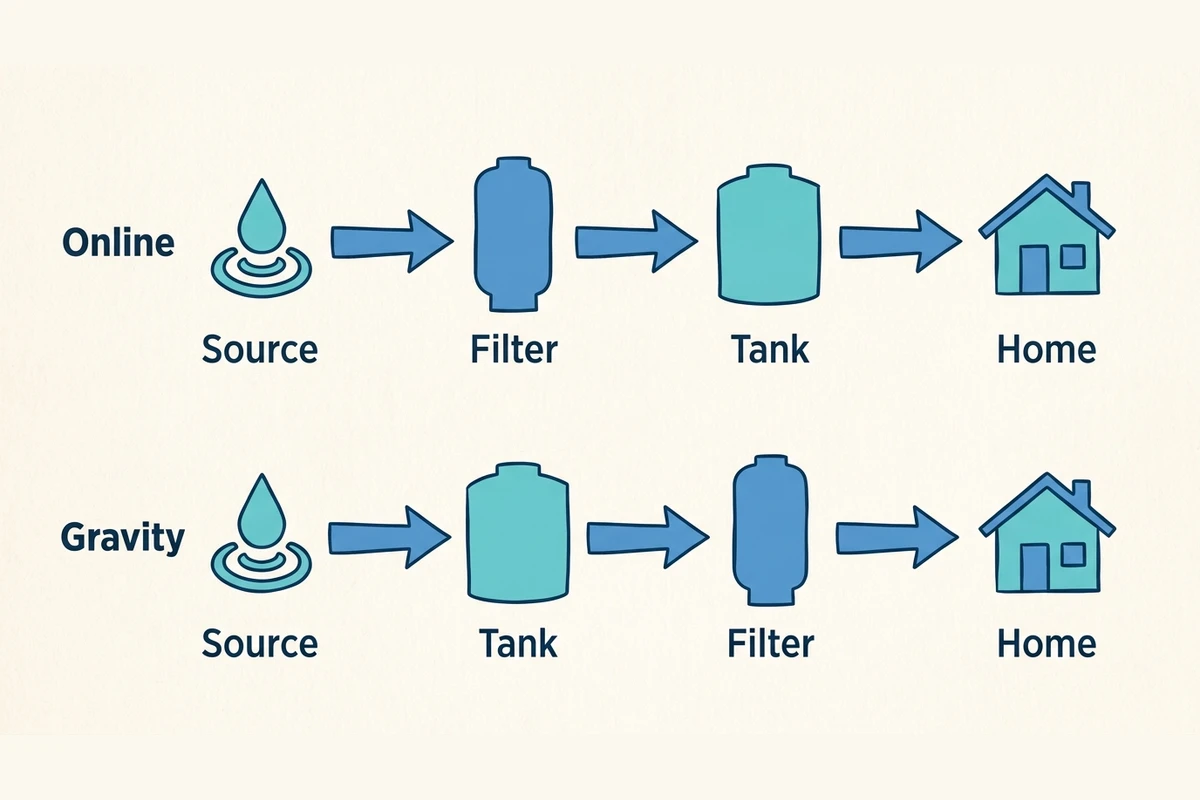
With the filter after the tank, the tank must push water through both the filter and the house pipes. An upstairs shower has less height between it and the tank water level than a downstairs tap. That can make the added resistance more noticeable upstairs.
Putting the filter before the tank removes that filter’s resistance from the tank-to-shower path. The pump filling the tank must still suit the filter. The house pipes and tank height still matter.
For older homes with long, winding pipe routes, we may choose online filtration after checking the site. If the water carries a heavy sand or silt load, a settlement stage may also be needed before filtration. The water test decides the treatment stages.
A booster may help the upstairs supply
A booster pump adds pressure to the supply. In a house where downstairs flow is comfortable but upstairs showers are weak, we may plan a booster for the upper-floor supply. Grundfos’s rooftop-tank guidance describes this kind of arrangement.
We choose the pump after checking the height it must serve and the water needed when taps run together. There is no single pump size that fits every house.
You may not need a booster. If cleaning the filter or fixing a restriction restores the flow, adding a pump may be unnecessary. Our whole-house systems page explains how we plan treatment around your water and plumbing.
Before installation, tell us which showers and taps are likely to run together. Ask to check the upstairs shower under those conditions before handover. That gives you a useful starting point if the flow changes later.
- Check where and when the shower gets weaker.
- Look at the narrowest passage through the valve and pipes.
- Keep backwashing matched to the filter’s needs.
- Choose the filter layout and any booster after checking the house.
Common questions about shower pressure
Will every whole-house filter need a booster pump?
No. A house with enough pressure and suitable plumbing may work well without one. Check the filter size and cleaning needs before adding a pump.
Why are the upstairs showers weaker than the downstairs taps?
An upstairs shower is closer to the overhead tank’s water level, so gravity provides less push. The filter and pipe route can use up more of that available pressure. The installer should check the upper-floor supply.
Can backwashing improve weak shower flow?
It can help when dirt in the filter media is restricting the water. If flow stays weak after the correct cleaning, the valve, pipes and supply need checking too.
Is online filtration the same as gravity filtration?
They put the filter in different places. Online filtration treats water before it reaches the overhead tank. Gravity filtration treats water after it leaves the tank, on its way to the house.
Plan the filter around your shower supply
Tell us about your tank, upstairs bathrooms and when the shower gets weak. Book a site visit to check the layout; a lab test is required before the final whole-house quote and system design.
Book a site visitOn this page
- Notice when the shower gets weaker
- Check the narrowest passage
- Backwashing helps keep water moving
- Filter placement changes the water path
- A booster may help the upstairs supply
- Common questions about shower pressure
- Will every whole-house filter need a booster pump?
- Why are the upstairs showers weaker than the downstairs taps?
- Can backwashing improve weak shower flow?
- Is online filtration the same as gravity filtration?