Borewell Water Settlement Tanks in Kerala: How to Size One
TL;DR
A settlement tank slows borewell water so sand, silt and rust drop out before your filters see them. We size it from your pump flow and your own water test.
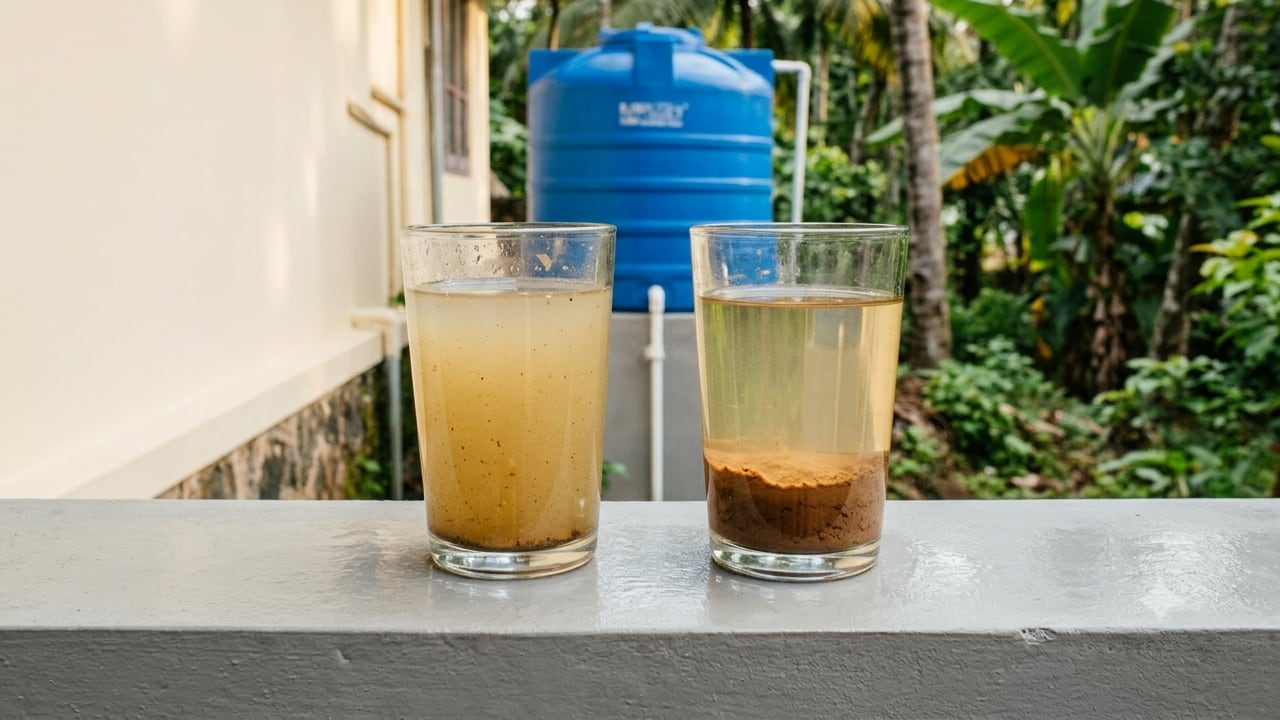
The water runs clear when the pump starts. An hour later there is a red-brown ring at the bottom of the bucket, and the white sink is stained again. That is the most common borewell water complaint we get in Thrissur, and a settlement tank is usually part of the answer. Only part.
A settlement tank slows the water down so the heavy bits drop out before the water reaches your filters and your taps. Gravity does all the work. Size it from your own water test and your own pump, and it takes most of the sand and rust load off everything after it. Buy it by litre capacity alone and you have bought a storage tank.
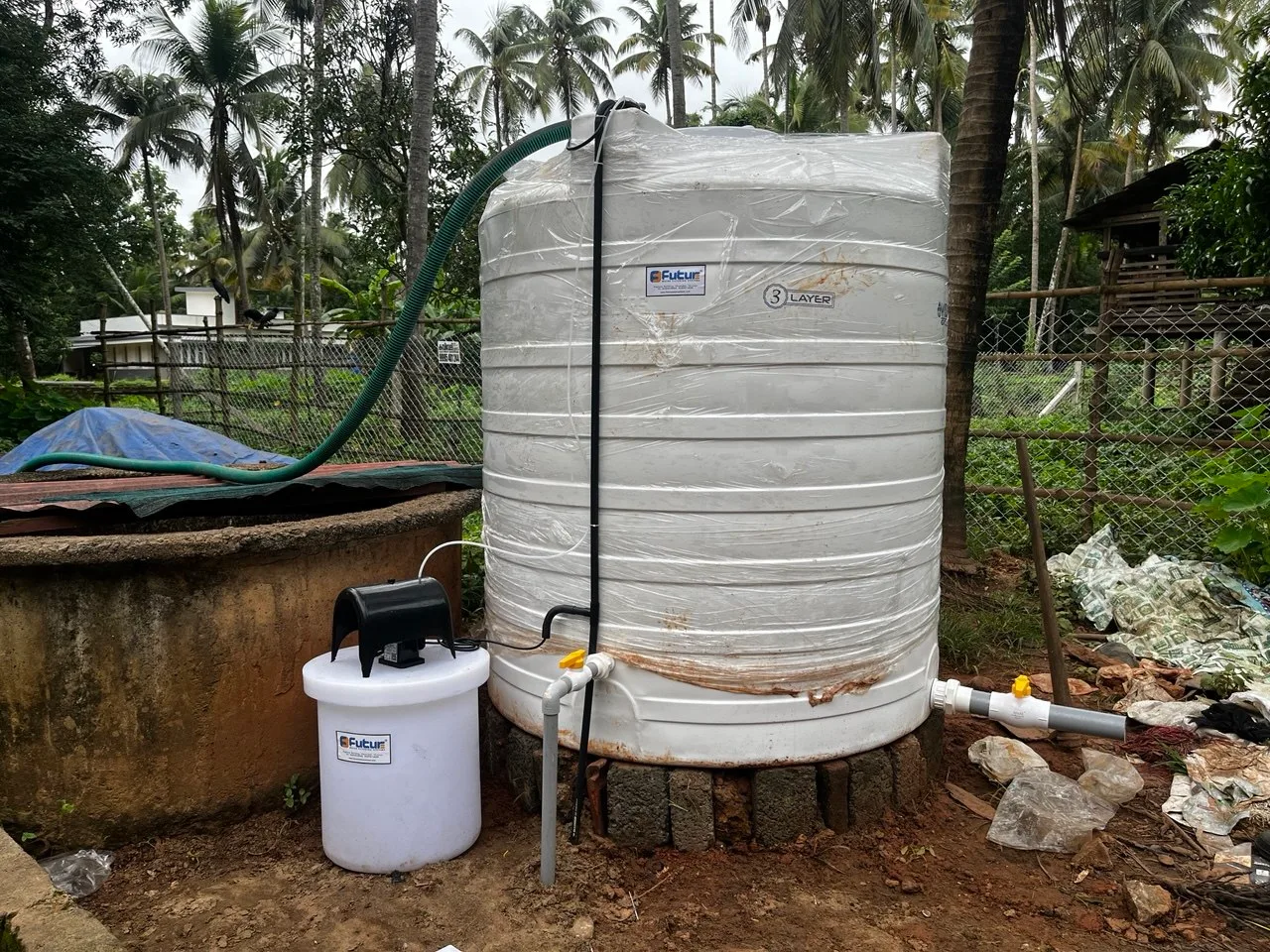
We call our way of doing this stage ClearFall. Future Water Systems has been sizing these tanks on Kerala wells since 2012, across more than 2,000 installations. The maths below is ordinary water engineering, published in government manuals. What we bring is knowing which of its assumptions survive a real well, a real pump, and a real monsoon. The tank looks simple. The numbers that set its shape are where a whole house water filter either works or quietly stops working.
Borewell water is four different problems
Groundwater changes with the rock, the depth, the rain, and how hard you pump. The Central Ground Water Board's 2024 Kerala bulletin names iron as a known groundwater problem and reports more of it in central Kerala, with Thrissur among the worst districts. The Kerala Water Authority tests for turbidity, pH, TDS (the amount of dissolved salt in your water), hardness, iron, and coliforms. Dirty-looking water tells you there is a problem. It does not tell you which one. We wrote about how much this varies street by street in Thrissur, Guruvayoor and Kunnamkulam.
A water test splits the problem four ways:
- Heavy bits: sand and grit. These drop fast once you calm the water.
- Fine bits: silt, clay, and rust flakes. These need more room, more time, or a chemical to clump them together.
- Dissolved things: hardness, salt, nitrate, and iron that is still in solution. These will not fall to the bottom no matter how long you wait.
- Bugs: bacteria and other germs. A settling tank does nothing to these. They need their own barrier.
So the tank follows the test, never the other way round. Sedimentation is the right first stage for a heavy solids load, and the right second stage after iron has been oxidised. Where the real problem is hardness or salt, it is the wrong buy.
A particle has to fall faster than the water carries it away
Gravity pulls a particle down. The moving water pushes it towards the outlet. A settling tank works when the particles you are targeting reach the bottom before they reach the outlet. That is the whole idea.
The number that decides it is the surface overflow rate:
Surface overflow rate = flow rate ÷ settling area
Written short: vo = Q ÷ A
Q is the flow you design for. A is the water surface area the tank actually gives you. A particle is caught when it falls faster than that rate. Notice what is missing: depth. A deep narrow tank and a shallow wide tank of the same volume behave very differently, and the wide one usually wins. Surface area does the work.
The Government of India's CPHEEO water treatment manual uses the same Q ÷ A rule and gives normal design ranges for plain settling. Those figures are written for town waterworks. A house still has to be sized from its own water, its own pump, and its own target.
Particle size matters more than you would guess
For small round particles falling on their own, Stokes' law ties settling speed to size, weight, and how thick the water is:
vs = g(ρp − ρw)d² ÷ 18μ
Skip the symbols and keep one thing: the diameter is squared. Halve the particle size and it falls four times slower. Coarse sand drops in seconds. Fine clay can hang in the water for hours. Real water is never a tidy set of identical spheres either, and particles clump, interfere, and change once air hits them. So we use the maths to set the starting shape, then watch how your actual water behaves in a jar or a column before we commit.
Time in the tank helps, but it is not the whole story
The other familiar number:
Holding time = usable volume ÷ flow rate
Written short: t = V ÷ Q
More time helps only if the whole tank is doing something. Water takes the shortest route it can find. A badly aimed inlet, an outlet drawing from one corner, an uneven floor, or a bed of old sludge will send some of the water straight from inlet to outlet in a fraction of the time you calculated. That is called short-circuiting, and it is why baffles, a calm inlet, outlet height, and a reachable sludge zone are part of the sizing rather than extras.
What the numbers look like on a real job
Take a house with a peak treatment flow of 3,000 litres per hour, which is 3 m³/h. Say the jar test and our safety margin point to an overflow rate of 0.75 m/h. The smallest settling area that gives us is:
A = Q ÷ vo = 3 ÷ 0.75 = 4 m²
If we then pick a two-hour holding time, the working volume is:
V = Q × t = 3 × 2 = 6 m³
That is still not a design. We would go on to check the pump's real delivery, the usable volume rather than the number on the label, how hard the inlet jet hits, the tank's proportions, room for sludge, outlet height, cleaning access, how the water changes between June and February, the load on the filters after it, and what happens the day the house draws more than we planned for. This is why "put in a 6,000 litre tank" is not a design. Two tanks of the same volume can perform nothing alike.
These numbers are an example only
Do not size your tank from them. Real sizing comes from your water test, your measured pump flow, your site, and what you want the water to be like at the tap.
Iron changes the order of the work
Iron is the one that fools people. Dissolved ferrous iron leaves the well looking perfectly clear. Once air reaches it, it turns into rust particles, and the water goes yellow, orange, or brown in the bucket. The World Health Organization's iron background document explains that iron(II) in water is unstable and drops out as iron(III), and that staining starts at fairly low levels.
That gives a fixed order of work:
- Measure the iron. How much, at what pH, and whether it is already a particle or still dissolved.
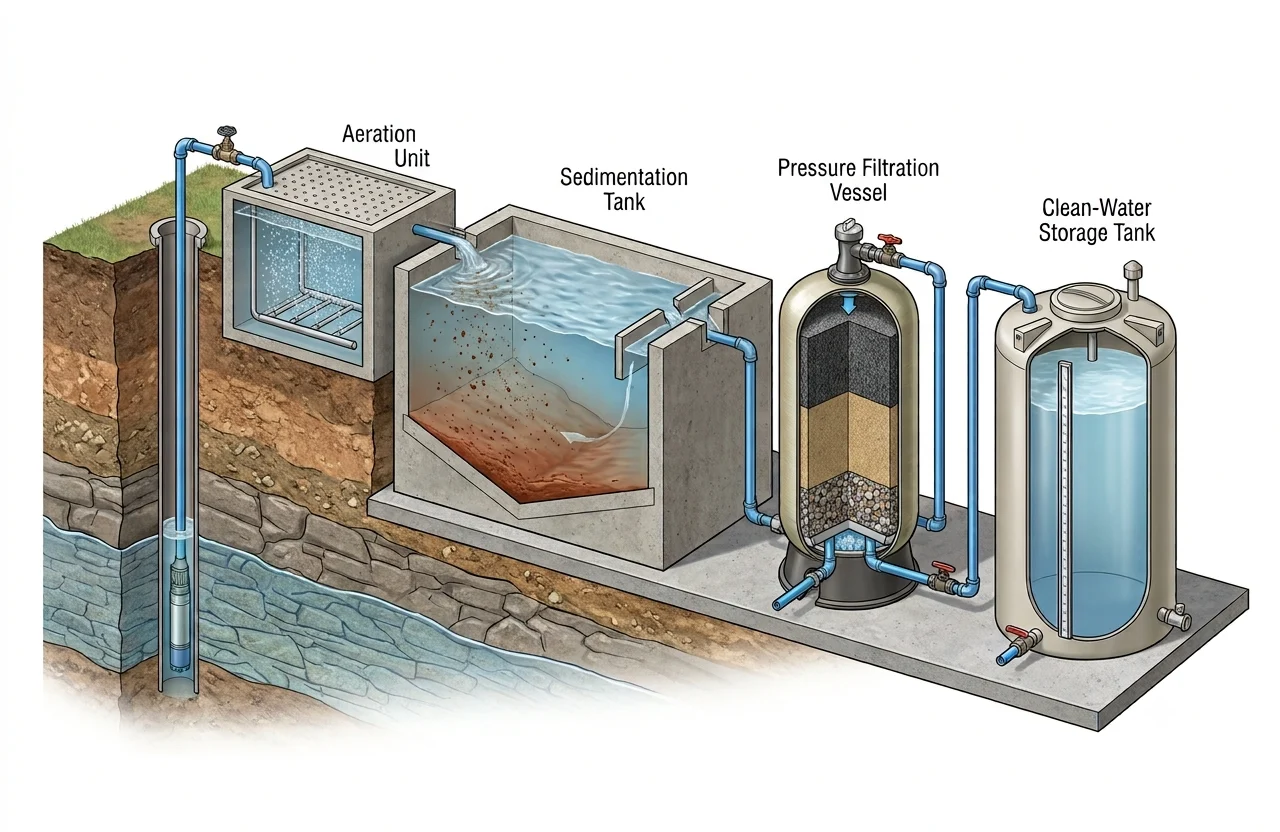
- Add air. Aeration, or another way of oxidising it, when the test says you need it.
- Give it time to react. Dissolved iron needs contact time to become something you can catch.
- Settle the heavy fraction. Drop the bulk of it out before it reaches fine filters.
- Filter the rest. With the right media, sized right. Settling is a first stage. Something always has to come after it.
The Government of India's Jal Jeevan Mission handbook sets out several different iron removal layouts. That is the point: there is no one vessel and media combination that suits every well.
The six things we work out before quoting
1. A water test that represents the source
The sample has to match the real well and the real season. Useful readings are turbidity, suspended solids, colour, pH, iron, manganese, hardness, alkalinity, TDS, and a bacteria check. Water drawn after it has already sat in a tank behaves differently from water taken straight off the pump, so where and when we sample matters as much as what we test for.
2. Peak flow, not daily usage
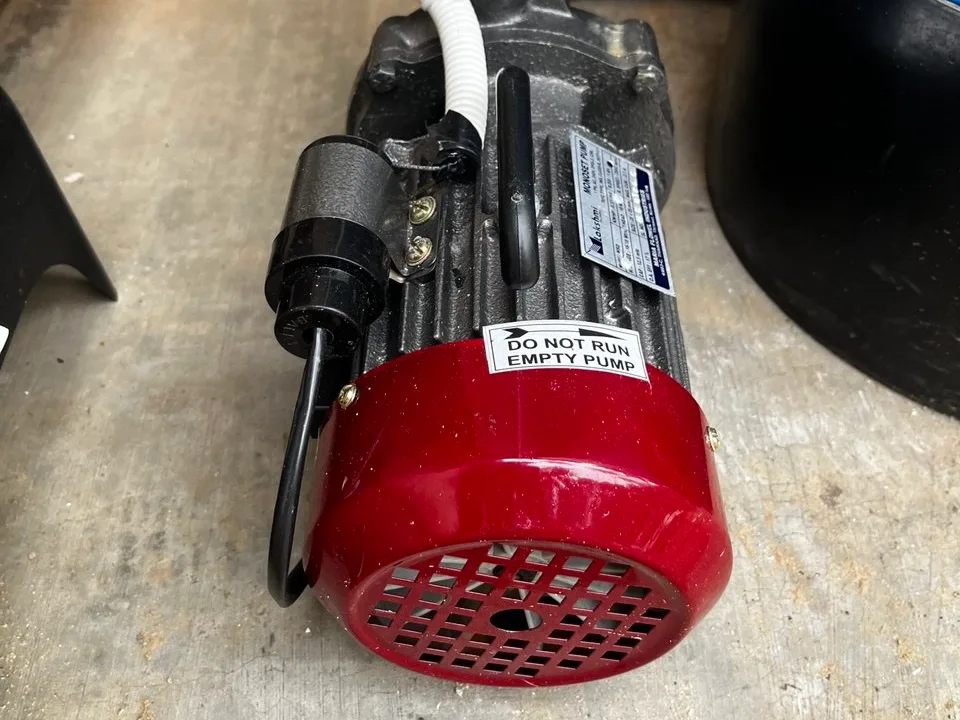
A house might use a modest amount over a day and still pull it through in two hard bursts when the transfer pump runs. The settling stage is judged in those bursts. So we separate daily use, pump output, what the house draws at once, running hours, and what you are likely to need in five years before we fix the design flow.
3. How your particles actually settle
Sand, fine silt, fresh iron floc, and clay all fall at different speeds. When the water is changeable or the solids are awkward, a settling column or a jar test shows how fast the load separates and how much simply refuses to.
4. Surface area and the path the water takes
We size the area against the target overflow rate. Then we lay out inlet, baffles, settling zone, outlet, and sludge zone so the tank we build behaves like the tank we calculated. Dead corners waste volume. Jets and sharp turns keep solids in suspension.
5. Where the sludge goes and who gets it out
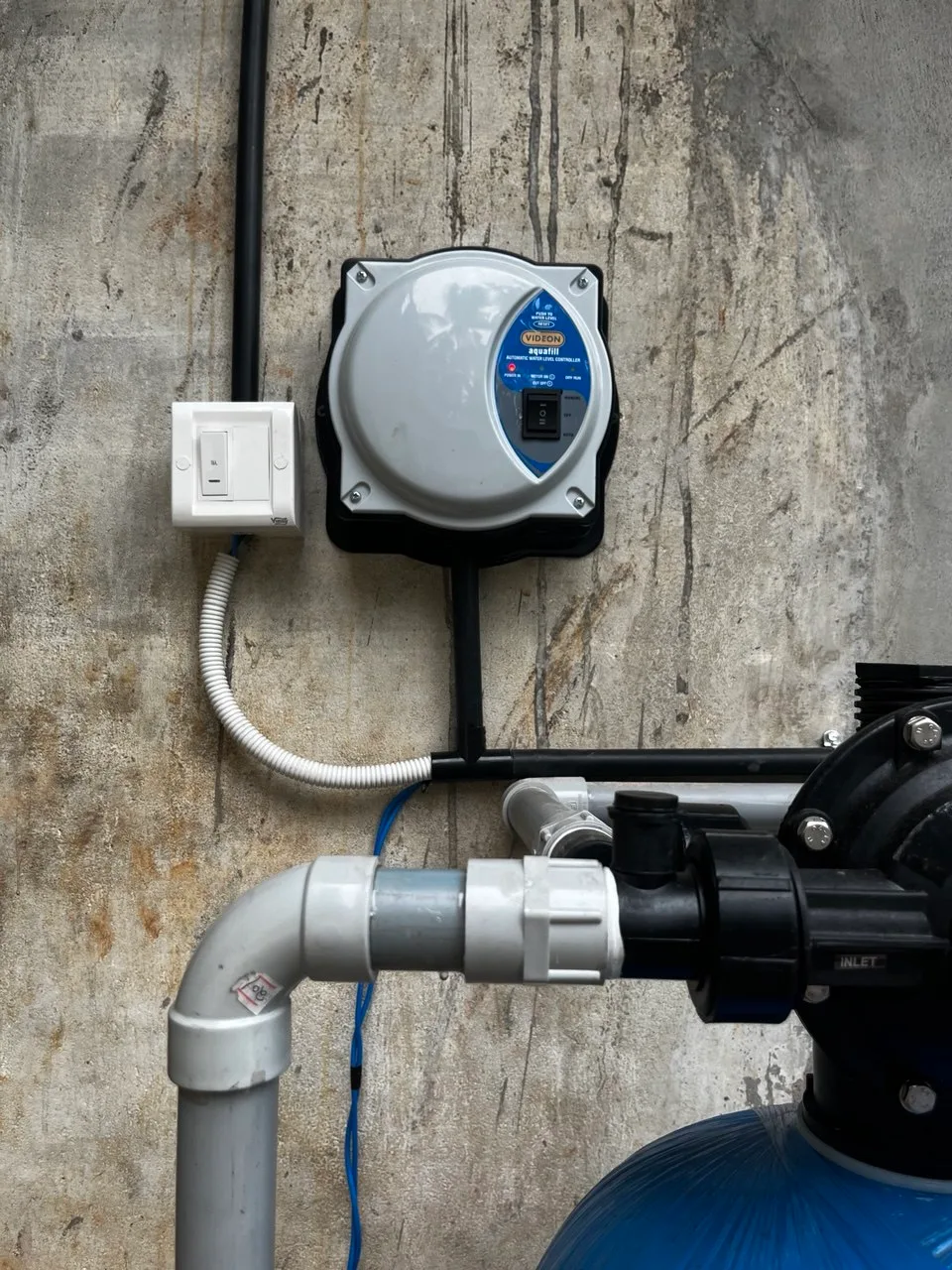
Everything the tank removes stays in the tank until somebody drains it. So the design needs a place for sludge to collect, a practical way to get it out, and a cleaning interval based on your real solids load. Skip that and the muck eats your working volume, stirs back up, and yesterday's catch becomes today's carryover. It is also why we keep installation and servicing under one roof. The people who sized the tank know how fast it should be filling.
6. The stages after it
Settling is designed as part of the whole chain. A pressure sand filter, iron removal media, activated carbon, a softener, UV, or a drinking water purifier each handle a different part of the problem. Our guide to whole house filtration walks through how those stages fit together, and what hard water does if you leave it for the settling tank to deal with. Good early treatment makes the filters after it run longer between cleans. It does not replace them.
Six shortcuts that make a tank fail
| Shortcut | What goes wrong | What we do instead |
|---|---|---|
| Tank picked by litres alone | Volume looks fine, but the surface is overloaded at peak flow. | Work out both Q ÷ A and V ÷ Q from the measured pump flow. |
| Pump discharges straight into the settling zone | The jet keeps particles up and stirs settled sludge back into the water. | Break up the inlet energy and spread the flow calmly. |
| Inlet and outlet too close together | Water short-circuits and most of the tank does nothing. | Separate them properly and add baffles where the shape needs them. |
| No aeration step for dissolved iron | Clear ferrous iron sails through, because it is not a particle yet. | Test iron and pH, then design the air and contact stage to match. |
| No plan for sludge | Deposits eat the working volume and eventually travel onward. | Fit a reachable drain and set a cleaning schedule. |
| Average demand used instead of pump flow | Fine when the house is quiet, fails whenever the pump runs. | Start the system up and test it at real peak conditions. |
When you do not need a settlement tank
Plenty of Kerala homes do not. If your water is clear in the bucket after standing overnight, leaves no grit in the tank, and the test comes back with hardness or salt as the main issue, a settling stage adds cost and cleaning work for very little return. Hardness is a softener's job. Salinity usually needs RO. Bacteria need UV. None of those are fixed by giving water somewhere quiet to sit.
We say so at the site visit. If a cartridge filter and a softener solve your water, that is what we quote.
What a settlement system costs
Whole house systems start at about ₹7,500 and run past ₹2,00,000. A settling stage is one part of that, so it sits inside the range rather than on top of it. Two things move the number. First, what your water needs: a single filter for one clear problem is at the bottom of the range, and a full ClearFall settlement system with tanks, pumps, and several treatment stages is at the top. Second, how much upkeep you want to do yourself. A basic system is cheaper and needs regular attention. An automatic one costs more and mostly looks after itself. No Cost EMI through Bajaj Finserv is available, and we quote only the stages your water test says you need.
The whole house vessel carries a 5 year warranty. Filter media typically runs 3 to 5 years before replacement, depending on your solids load.
What a settlement guarantee can cover
One tank does not remove every substance from any water forever, and nobody can promise that. Settling has a defined job: take out the agreed settleable solids, at a defined flow, from water within a defined range. Hardness, salt, dissolved chemicals, and bacteria each need their own barrier.
For the promise to mean anything, five things have to be written down:
- The water going in: the tested source, and the range the design can cope with.
- The target: the specific problem this stage is meant to reduce.
- The operating limits: maximum flow, pumping pattern, and any air or dosing the design assumes.
- The upkeep: sludge draining, cleaning, media service, and inspection.
- The check: what we look at, and test, after the system is running.
That is what turns a guarantee into something measurable. It also protects you. If the well, the pump, or your usage changes later, we can reassess against known limits instead of guessing.
How we design and hand over a ClearFall system
- Talk at the site: staining, grit, smell, how the water changes with the season, tank cleaning history, the source, and what the house uses.
- Test the water: the readings needed to tell settleable, dissolved, and bacterial problems apart.
- Measure the flow: what the pump really delivers, and how the house draws it.
- Watch it settle: a jar or column check when the water or the particles call for it.
- Do the sizing: design flow, surface loading, usable volume, holding time, sludge allowance, and margin.
- Design the chain: put settling in the right place relative to aeration, filtration, softening, UV, and storage.
- Install it: keep the calculated flow path with the right pipe sizes, inlet control, outlets, drains, and service access.
- Start it up: run it at real flow, look for carryover, watch the pressure, and confirm the agreed result.
- Hand it over: explain the limits and the few small jobs that keep it working.
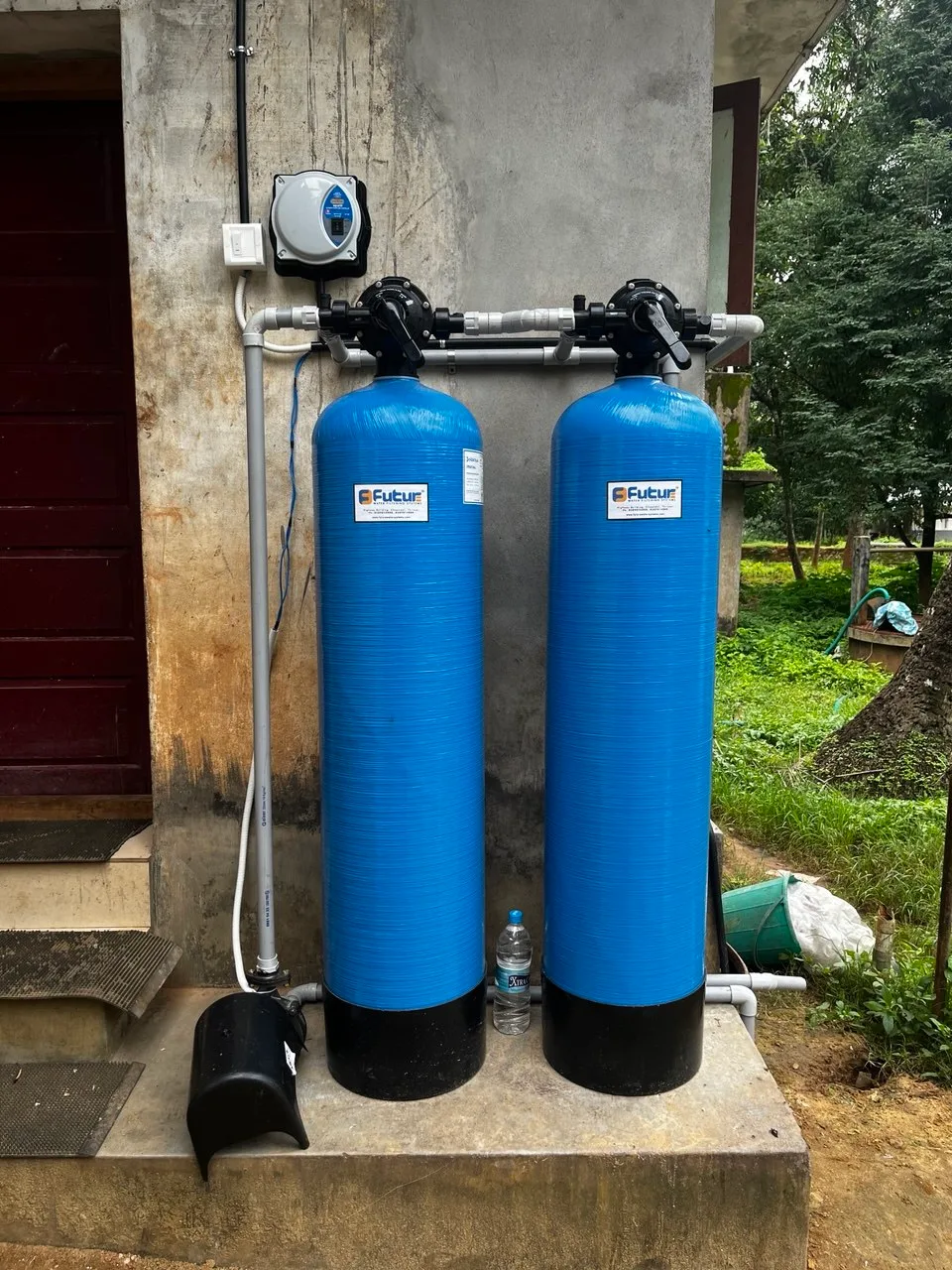
Sreelakshmy Sivadas in Guruvayoor, who had a whole house system put in, wrote afterwards:
"I would like to highlight the polite and helpful attitude here at Future Water Systems. Their team was kind enough to give a very detailed explanation that taught me a lot. It felt like a knowledge sharing session and in no way turned into a sales pitch."
Common questions about settlement tanks
Is a settlement tank enough to make borewell water safe to drink?
No. It removes the share of suspended material that settles under the conditions it was designed for. It does not remove hardness, salt, nitrate, dissolved iron, or germs. Your water test decides which other barriers you need.
Will a bigger tank always give better results?
Not always. More area or more usable volume can help, but a poorly aimed inlet, short-circuiting, too much peak flow, or a floor full of old sludge will make a big tank perform badly. Shape and flow path count alongside capacity.
Can a settlement tank remove iron from borewell water?
It can, once the dissolved iron has been turned into particles big and heavy enough to fall. Fine carryover still needs a filter after it. The right sequence depends on how much iron there is, the pH, the flow, and which form the iron is in.
How often does the sludge need removing?
There is no honest universal answer. It depends on how much solid your water carries, how much you use, the sludge space in the tank, and how the well changes with the seasons. We set a cautious interval at handover and adjust it once we see how fast it actually fills.
Does a settlement system use chemicals?
Plain settling may use none. Some water needs aeration, pH correction, or a coagulant to turn fine or dissolved material into something that will drop. What gets dosed, and how much, comes from the water test.
How long does a whole house system take to install?
Most whole house installations are a one-day job once the tanks and plumbing points are ready. Sites needing civil work for a settling tank take longer, and we will say so before you commit.
Start with your water test
If your borewell leaves grit in the tank, rust rings in the bucket, stained fixtures, or filters that clog far too fast, the first step is finding out what is in the water. We will tell you what can be settled out, what has to be oxidised first, what needs a filter or a softener after that, and what we can put in writing.
A site visit means we look at your well, your pump, and your tanks, take a sample, and measure the flow. You get the readings and a quote for the stages your water actually needs. See our whole house water treatment systems, or book a water assessment. We work across Thrissur, Guruvayoor, Chavakkad, Kunnamkulam, Wadakkanchery, Irinjalakuda, Chalakudy, Kodungallur, and Ernakulam.
Technical references
- Ministry of Housing and Urban Affairs / CPHEEO: Manual on Water Supply and Treatment, Chapter 8
- Jal Jeevan Mission: Handbook on Drinking Water Treatment Technologies
- World Health Organization: Iron in Drinking-water background document
- Central Ground Water Board: Kerala Groundwater Chemical Quality Bulletin, Pre-monsoon 2024
- Kerala Water Authority: Water Quality Control programme
- A settlement tank uses gravity to drop sand, silt and rust out of borewell water before it reaches your filters.
- Size it from your measured peak pump flow and your own water test, never from litre capacity alone.
- Surface area matters more than depth. A wide shallow tank usually beats a deep narrow one of the same volume.
- Dissolved iron has to meet air and turn into a particle before any tank can settle it out.
- Settling does nothing for hardness, salt or bacteria. Those need a softener, RO or UV after it.
- Whole house systems run from about Rs 7,500 to past Rs 2,00,000, and the vessel carries a 5 year warranty.
Need help with your water?
The first whole-house site visit includes consultation, TDS and pH readings, and a visual site assessment. A lab test is required before the final quote and system design.
Book a consultationOn this page
- Borewell water is four different problems
- A particle has to fall faster than the water carries it away
- Particle size matters more than you would guess
- Time in the tank helps, but it is not the whole story
- What the numbers look like on a real job
- These numbers are an example only
- Iron changes the order of the work
- The six things we work out before quoting
- 1. A water test that represents the source
- 2. Peak flow, not daily usage
- 3. How your particles actually settle
- 4. Surface area and the path the water takes
- 5. Where the sludge goes and who gets it out
- 6. The stages after it
- Six shortcuts that make a tank fail
- When you do not need a settlement tank
- What a settlement system costs
- What a settlement guarantee can cover
- How we design and hand over a ClearFall system
- Common questions about settlement tanks
- Is a settlement tank enough to make borewell water safe to drink?
- Will a bigger tank always give better results?
- Can a settlement tank remove iron from borewell water?
- How often does the sludge need removing?
- Does a settlement system use chemicals?
- How long does a whole house system take to install?
- Start with your water test
- Technical references
Share Article
Need help with your water?
The first whole-house site visit includes consultation, TDS and pH readings, and a visual site assessment. A lab test is required before the final quote and system design.
Book a consultation